Insights
Thought Leadership

Wouter Kritzinger
SEO Director, dentsu Performancemedia
ABOUT
As Google rolls out AI Overviews across search, many businesses fear the end of organic traffic. In this article, Dr Wouter Kritzinger separates fact from fiction, explaining how Google's AI-powered search actually works, why authoritative content remains essential, and what organisations should do to stay visible. From technical SEO fundamentals and structured data to creating experience-led content that AI cannot replicate, he outlines a practical roadmap for succeeding in the next era of search.
Every week, I speak to businesses who are worried. Sometimes panicked. It does not matter whether they run a local plumbing business, a fast‑growing Shopify store or a large, content‑led site, the question is always the same:
Is Google’s new AI search going to wipe out our organic traffic?
It is an understandable fear. The headlines are dramatic. Zero‑click search. The end of SEO. AI answers replace websites.
But when you step back and look at how Google’s AI Overviews work, a more grounded picture emerges. One that is far less apocalyptic, and in many cases, more commercially promising.
Because this is not a new search engine. It is the same Google, using the same ranking systems, asking tougher questions about quality.
What Google’s AI is really doing?
The summaries now appearing at the top of search results, AI Overviews are not generated from thin air.
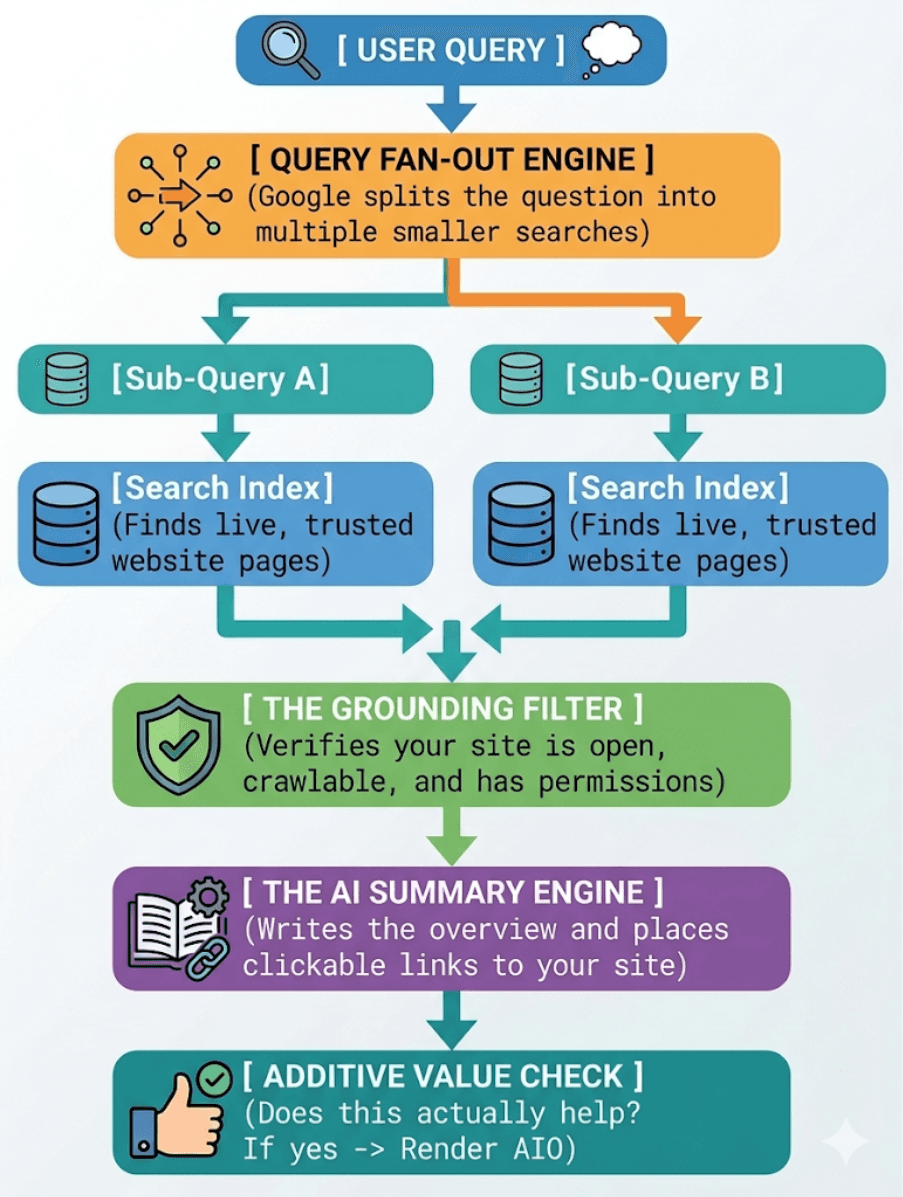
Google does not allow its AI to invent answers based on training data alone. That would quickly lead to outdated information and fabricated facts. Instead, it uses a process known as retrieval‑augmented generation, or, more simply, grounding.
Here is how it works.
When someone searches, Google:
Runs a standard search.
Selects a set of high‑ranking, trusted pages.
Reads them at speed.
Summarises what they collectively say.
In other words, AI Overviews are built on top of the web, not in place of it.
AI Overview example
For more complex queries, Google goes a step further using query fan‑out.
If someone searches “how to fix a patchy lawn in spring,” Google does not just look for that phrase. It silently runs multiple related searches; soil aeration, seed types, fertiliser timing, and blends those results into a single response.
The important detail? Your content is far more likely to appear if Google already recognises it as authoritative.
When Google chooses not to show an AI Overview
AI Overviews do not appear on every search.
Google applies what it calls an additive filter. The system asks a simple question: does an AI‑generated summary genuinely help the user here?
If the answer is no, for example, someone checking the time in Tokyo or a share price, Google simply serves a direct data result. No AI summary, no citations, no links.
That distinction matters. Because it tells us something important about where search is heading.
The traffic that remains is better traffic.
Yes, AI Overviews can absorb some quick, low‑intent clicks. But the users who do click through after reading an AI summary behave very differently.
They have already:
Read a condensed explanation.
Compared multiple sources.
Decided your site is worth their time.
Across many of the sites we manage, we are seeing consistent patterns from AI Overview traffic:
Lower bounce rates
Longer engagement times
Stronger conversion intent
AI Overviews are not removing value. They are filtering for it.
The technical reality: if Google cannot read you, you are invisible.
Before worrying about content strategy, there is a more basic question to answer: can Google’s systems access your site?
You can publish the most useful article in your industry. If your technical setup blocks summarisation or slows access, Google will simply move on.
The most common mistake we see.
Many sites unintentionally block AI Overviews using nosnippet, or overly restrictive max‑snippet settings. This often happens through developer defaults or over‑zealous security plugins.
When that happens, Google is technically prevented from summarising your content.
You can check this using the URL Inspection Tool in Google Search Console.
There is a similar trade‑off with Google‑Extended. Blocking it prevents your content from being used to train future AI models, which may be desirable from a privacy perspective. Google states this does not affect rankings, but businesses should still weigh that decision carefully as AI‑driven search experiences continue to evolve.
Speed still matters.
AI systems operate at scale and at speed.
If your site is slow to respond, or if an aggressive security system blocks Google during high‑speed query fan‑out, your content may not be considered at all.
Four technical basics that still decide everything.
You do not need exotic AI optimisation. You need clean fundamentals.
Clear page structure
Use proper HTML headings and paragraphs. This gives Google a clear map of what matters on the page.JavaScript restraint
If your content only appears after heavy script rendering, Google may not see it in time.Page speed and pop‑ups
If a user clicks from an AI Overview and hits a slow load or intrusive overlay, they bounce — and Google notices.A clean sitemap
Remove broken, duplicated, and outdated pages. Make it easy for Google to find your best work, fast.
Why generic content is no longer enough.
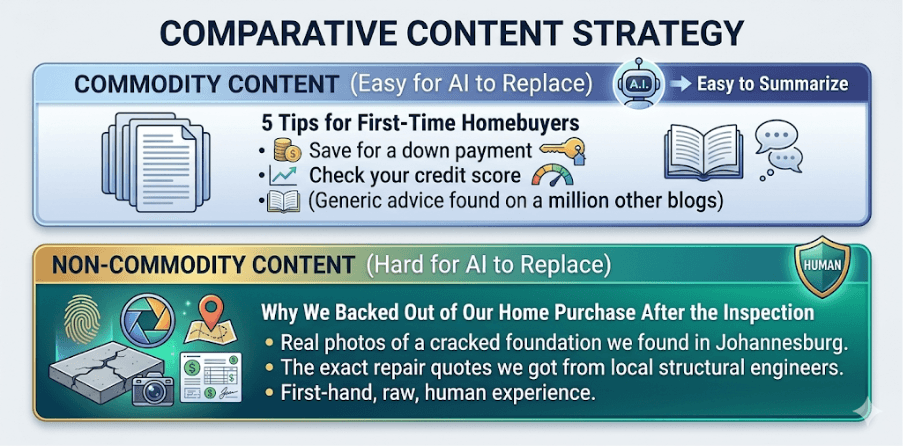
For years, many sites survived on what we call commodity content.
You know the type:
“Five tips for buying a house.”
“What is a deductible?”
“Everything you need to know about X.”
Here is the problem.
If Google’s AI can summarise your page in three bullets, why would a user need to visit your site at all?
The content that survives, and benefits, from AI Overviews is non‑commodity content. Material rooted in genuine experience.
A generic article about foundation repairs is easy to summarise.
A case study from a specific city, with real photos, actual costs and real outcomes, is not.Google’s AI cannot crawl under a house with a torch. So, it must cite the people who have.
How to make content AI‑resistant (in an effective way)
Most businesses already have what AI cannot replicate. They just do not document it.
Three practical shifts are effective:
Take a position
Stop writing neutral summaries. Share what works, and what does not, based on experience.Show evidence
Use original photography, real numbers, real obstacles, and real fixes. Prove you have done the work.Use proper visuals
AI Overviews often surface image thumbnails. Original, well‑labelled images outperform stock every time.
A word on AI‑generated content
Using AI to scale out hundreds of generic posts is tempting, and risky.
Google is explicit about filtering scaled, low‑value content. More importantly, this type of writing is exactly what AI Overviews summarise without sending traffic back to your site.
Used carefully, AI can support research and structure. Used carelessly, it replaces you.
E‑commerce and local businesses: data beats prose
If you sell products or services, you are not just competing with articles. You are competing inside Google’s databases.
For e‑commerce
As search moves towards more agent‑driven experiences, Google relies on structured product data to compare pricing, availability, and delivery in real time.
If your schema is incomplete or outdated, those automated systems simply will not surface your products, regardless of how strong your content is.
For local businesses
Your Google Business Profile is no longer optional. It is a live data feed.
When users ask questions like: “Find a plumber near me who’s open after 5pm and works with tankless systems” Google queries local databases first.
Incomplete profiles, vague service descriptions, or unverified hours mean exclusion.
The practical checklist
To make this simple, here is a quick, practical checklist you or your team can work on starting today.
What to Focus On | What to Do | Why It Matters |
Check Your Snippets | Use Google Search Console to verify your pages are not blocked by nosnippet tags. | Allows Google's AI to legally read and link to your content. |
Speed Up Your Site | Check your page load speed and remove annoying, shifting pop-ups. | Prevents users from bouncing back to Google when they click your link. |
Audit Your Content | Find your top pages and replace generic advice with real-world case studies and photos. | Ensures your site provides unique value that the AI cannot simply summarise. |
Optimise Your Images | Use original photos (no stock images) with descriptive filenames and alt-text. | Helps you capture the highly visible thumbnail slots inside AI Overviews. |
Sync Your Profiles | Completely fill out your Google Business Profile and Merchant Centre feeds. | Ensures you show up when the AI searches for local services or product sales. |
What to stop doing
Some habits actively work against you in AI‑driven search:
Stop worrying about experimental files like llms.txt. Google still reads HTML and schema.
Stop breaking content into thin, fragmented pages. Depth now beats volume.
Stop keyword stuffing. AI understands natural language.
Stop buying low‑quality backlinks. Authority is earned, not purchased.
Measure what matters!
In AI search, raw traffic is becoming a vanity metric.
If someone gets a quick answer and does not click, they were unlikely to convert anyway.
What matters now:
Conversion rate
Time on site
Depth of engagement
The users who click after reading an AI Overview are informed, intentional, and far more likely to act.
The goal is no longer maximum visibility. It is meaningful visibility, with the right customers.
RELATED ARTICLES

Retail Media Is Growing Fast. Standards Are Not.
Building Measurement Confidence
Insights
News
Thought Leadership

DENTSU AFRICA PULSE | WEEK OF 25 SEPTEMBER 2026
Signals. Strategy. Growth.
Insights
News

Africa cannot afford another decade of potential
Building Leadership
Insights
News
Thought Leadership
Events

While Others Talk, dentsu Builds Creators
Building Sustainable Influence
News
Our latest work

Ready to grow?
LET'S TALK