Insights
News
Thought Leadership

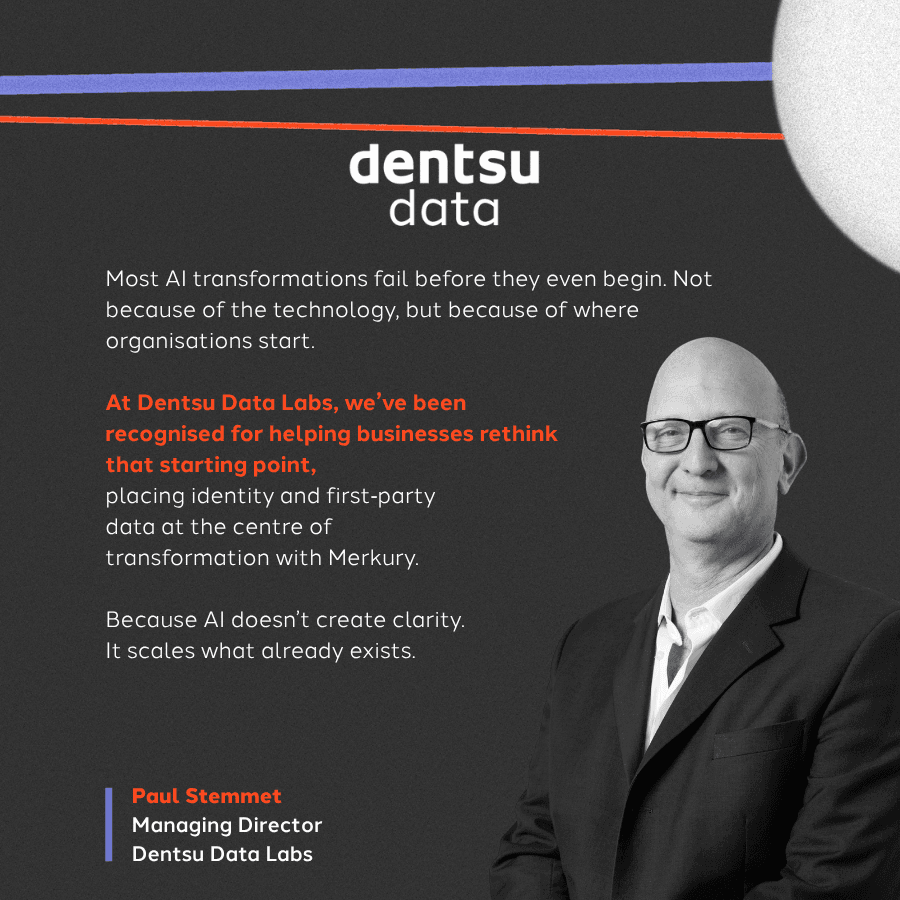
Paul Stemmet
Managing Director, Dentsu Data Labs, Dentsu Africa
ABOUT
As organisations race to adopt AI, many initiatives fail to deliver meaningful business impact. The reason is not the technology itself, but the absence of a clear, unified understanding of the customer. Drawing on Telkom's transformation journey with dentsu Merkury, this insight explores why identity and first-party data are the true foundations of enterprise AI success. It reveals how organisations can move beyond fragmented data and isolated pilots to embed intelligence into decision-making, unlock new commercial opportunities, and drive sustainable growth.
Across Africa and globally, organisations are accelerating investment in AI.
The ambition is clear: improve efficiency, unlock growth and future‑proof the business.
Yet despite this momentum, many AI initiatives fail to scale or deliver meaningful impact. The issue is rarely the technology. The difference is where organisations start.
The real problem is not AI. It is understanding the customer.
Most AI programmes start with tools. New models. New platforms. New automation. What they often lack is a unified, usable understanding of the customer.
Data exists in abundance, but it is fragmented across systems, channels, and teams. Identity is duplicated, inconsistent or inferred.
In this environment, AI does not create clarity. It simply accelerates fragmentation.
True transformation starts earlier. It starts with identity. It starts with first‑party data. Without this foundation, AI remains an experiment rather than a business capability.
What enterprise AI transformation looks like.
At Telkom, the challenge was not a lack of data. It was fragmentation, and the growing pressure to unlock value from it.
Customer, behavioural and transactional signals existed across the organisation, but they were disconnected and underutilised.
As competitive intensity increased and traditional revenue streams came under pressure, incremental optimisation was no longer sufficient.
What was needed was not another layer of technology, but a way to bring clarity to the customer.
By applying a person‑based identity approach, enabled through dentsu Merkury, Telkom unified its first‑party data into a single, actionable view of the customer.
This unlocked previously inaccessible intelligence and allowed it to be applied across the business, not just within campaigns.
The impact was tangible and sustained:
A consistent, unified view of customers across channels
More relevant, commercially meaningful engagement
The ability to activate first‑party data at scale, in real time
Most significantly, Telkom moved beyond campaign optimisation.
It established South Africa’s first telecom data marketplace, creating an entirely new commercial model from existing data assets.
This was not an AI pilot. It was a shift in how the business operates.
Why identity is the foundation of AI value
AI is only as effective as the data it is built on. Without accurate, persistent identity:
Organisations rely on proxies
Decisions are based on incomplete signals
Value is lost between systems
A strong identity foundation, built for the realities of fragmented, multi-channel markets, enables organisations to securely connect their data, resolve individuals consistently and apply intelligence across the entire customer experience.
AI becomes valuable when it is embedded into decision making, not layered onto existing processes.
The leadership shift required
AI transformation is not primarily a technical challenge. It is an organisational one. It requires leaders to rethink:
Data ownership and governance
Collaboration across silos
How success is measured
How operating models evolve
Without this shift, AI will consistently underdeliver.
A Better Place to Start
AI will not transform businesses on its own. Businesses that deeply understand their customers will.
When identity is clear, data is connected and intelligence is applied with intent, AI becomes a genuine driver of growth. Without that foundation, it remains complexity disguised as progress.
The difference is not the technology. The difference is where you start.
Increasingly, the organisations seeing real value are the ones willing to step back, rethink that starting point, and build from a foundation that reflects how their customers live, behave, and connect.
That is where the real work begins, and where the right partners make all the difference.
RELATED ARTICLES

Marketers Are Planning for a Consumer That No Longer Exists
Consumers Changed. Marketing Must.
Insights
News
Thought Leadership

Retail Media Is Growing Fast. Standards Are Not.
Building Measurement Confidence
Insights
News
Thought Leadership

DENTSU AFRICA PULSE | WEEK OF 25 SEPTEMBER 2026
Signals. Strategy. Growth.
Insights
News

Africa cannot afford another decade of potential
Building Leadership
Insights
News
Thought Leadership
Events

Ready to grow?
LET'S TALK